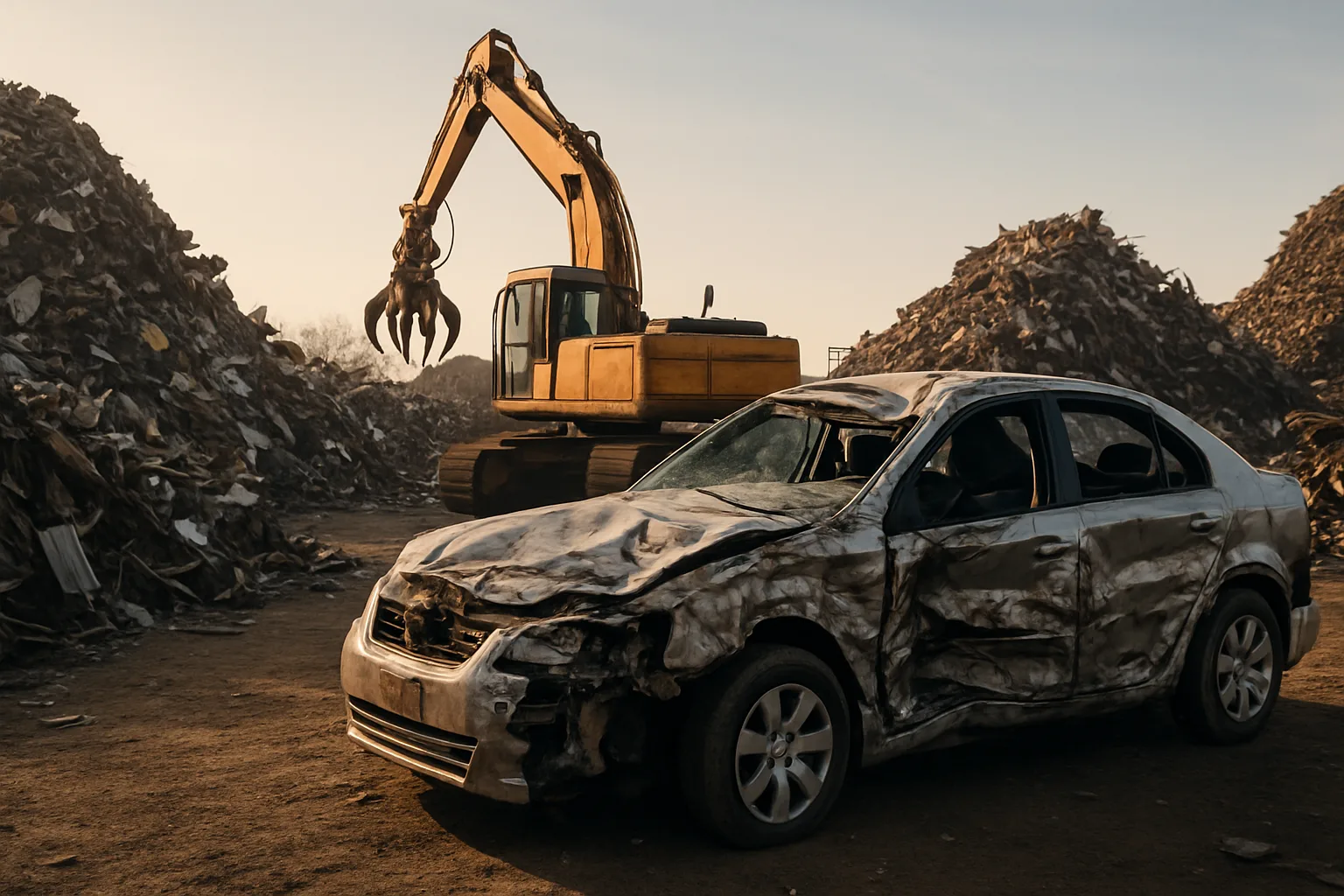
What Happens to Your Car After a Collision? Here's What You Need to Know Before You Scrap It
Nearly 160,000 vehicles are written off in Canada every year — and a significant portion of those owners have no idea what their wrecked car is actually worth as scrap. If you've just had an accident and you're sitting with a totalled or heavily damaged vehicle, the instinct is to panic. Don't. That car still has value, even if it'll never drive again.
This guide is specifically for vehicle owners in Trois-Rivières and across Quebec who want to sell scrap car Trois-Rivières after a collision — without getting lowballed, without the runaround, and without towing fees eating into your payout.
---Does a Collision-Damaged Car Have Scrap Value? (Yes — Here's Why)
A car that's been in an accident is still made of steel, aluminum, copper wiring, and other metals with real market value. The frame might be bent. The airbags deployed. The glass shattered. None of that eliminates the scrap value hiding inside the vehicle.
Here's what actually gets recycled from a wrecked vehicle:
- Steel and iron — The body, frame, and chassis make up the bulk of the vehicle's weight and scrap value.
- Aluminum — Wheels, engine blocks, transmission housings, and body panels on newer vehicles.
- Copper — Wiring harnesses, motors, and sensors.
- Catalytic converter — This is often the single most valuable part on the car. It contains platinum, palladium, and rhodium — precious metals that hold significant value even when the rest of the vehicle is a write-off.
- Usable parts — Doors, mirrors, suspension components, and electronics that survived the crash can be pulled and resold before the vehicle goes to the crusher.
The bottom line: a 2012 sedan that took a head-on hit is still carrying roughly 1,200–1,500 lbs of recyclable steel alone. Scrap buyers aren't looking at the dents — they're looking at the weight and the metals.
The Catalytic Converter Question — Don't Leave Money on the Table
If your accident-damaged vehicle still has its catalytic converter intact, pay attention. Cats are the most misunderstood component in scrap vehicle sales. Most people hand over a totalled car without realizing the converter attached to the exhaust system can represent a meaningful chunk of the total payout — sometimes more than the steel weight of the whole vehicle.
Converter values vary widely depending on the make, model, and year of the vehicle. A domestic truck converter and a foreign luxury sedan converter are not worth the same. The precious metal content is entirely different. This is exactly why platforms like SMASH Recycling — where verified buyers bid on your metal exist. Instead of accepting whatever a single buyer quotes you, SMASH puts your catalytic converter in front of multiple vetted buyers simultaneously. Competition replaces guesswork. That's better price discovery — full stop.
Before you hand over your collision-damaged car, confirm whether the catalytic converter is still attached and intact. If it is, make sure whoever is buying your scrap vehicle is accounting for its value — not just the steel weight.
What Documents Do You Need to Sell a Wrecked Car in Quebec?
Scrapping a collision-damaged vehicle in Quebec involves a few more paperwork steps than selling a running car. Don't let this slow you down — but don't skip it either.
Here's what you'll typically need:
- Vehicle title (certificate of registration) — Proof that you legally own the vehicle. If the car was totalled by your insurer, confirm whether ownership transferred to them or remained with you.
- Insurance settlement documentation — If your insurer declared the vehicle a total loss and paid you out, you may need to clarify the transfer of ownership before scrapping.
- Government-issued ID — Standard for any vehicle transaction in Quebec.
- SAAQ notification — In Quebec, you're required to notify the Société de l'assurance automobile du Québec (SAAQ) when a vehicle is transferred or scrapped. This removes the vehicle from your record and stops any ongoing registration liability.
If you're in Trois-Rivières and you're unsure about the paperwork process post-accident, a reputable scrap car removal service will walk you through it. A good buyer doesn't make this harder than it needs to be.
Free Scrap Car Pickup Trois-Rivières — What to Expect on Pickup Day
One of the most common concerns after an accident is the logistics. Your car might not run. It might be sitting at a collision shop, in a driveway, or in a parking lot. Free scrap car pickup Trois-Rivières means you don't need to figure out how to move it yourself — the buyer comes to you with a flatbed or rollback tow truck and handles the whole thing.
Here's what the pickup process typically looks like:
- Quote call or online quote — You describe the vehicle (year, make, model, condition, whether the catalytic converter is present) and get an offer.
- Scheduling — Most services can pick up within 24–48 hours in and around Trois-Rivières. Same-day pickup is sometimes available.
- Vehicle inspection on arrival — The driver does a quick visual confirmation that the vehicle matches what was described.
- Payment — You're paid at time of pickup, either by cash, e-transfer, or cheque depending on the service.
- Title transfer and paperwork — You sign over the title. Keep a copy for your records and complete your SAAQ notification.
Before pickup, remove all personal items from the vehicle. Check the glove box, trunk, under seats. Collision-damaged cars are easy to forget things in — especially if the accident was recent and stressful. Also remove your license plates; in Quebec, plates stay with the owner, not the vehicle.
You can schedule your free scrap car removal directly through GetMyScrapCar — no towing fees, no hidden charges.
Why Single-Buyer Deals Cost You Money — The SMASH Difference
Here's the old way of scrapping a car in Quebec: you call one yard, they give you a number, you take it or leave it. You have no idea if that number is fair. You have no leverage. You're guessing.
That model is broken — especially for accident vehicles where the value is harder to assess at a glance. A car that looks like a total write-off might have a high-value catalytic converter, a sought-after aluminum block, or usable parts a secondary buyer would pay a premium for.
SMASH changes the dynamic. The SMASH platform connects sellers with vetted, verified buyers who compete for your vehicle and its components. More buyers means better price discovery. Documented inventory — photos, VIN lookup, serial tracking — gives buyers the confidence to bid higher because they know exactly what they're getting. No surprises, no lowball games.
For vehicle owners in Trois-Rivières looking to sell scrap car in Quebec after an accident, this matters. You're already dealing with the aftermath of a collision. The last thing you need is to leave money behind because you accepted the first number someone gave you. Platforms like SMASH make it easy to let the market decide what your metal is worth.
Want to understand how auction-based scrap selling works? Read more junk car removal guides on the GetMyScrapCar blog.
How to Get the Best Payout for Your Accident-Damaged Car in Trois-Rivières
You don't need to be a scrap metal expert to get a fair deal. You just need to be informed. Here's a practical checklist before you sell:
- Confirm the catalytic converter is still on the vehicle — and that your quote reflects it. This is non-negotiable.
- Know your vehicle weight — Heavier vehicles (trucks, SUVs, vans) yield more scrap steel. A pickup truck generates significantly more per vehicle than a compact sedan.
- Get more than one quote — Even a second quote gives you a baseline. Multiple quotes give you leverage.
- Document the vehicle with photos — Good documentation protects you and gives buyers confidence. It also speeds up the transaction.
- Check if any parts can be sold separately — Intact doors, bumpers, or electronics that survived the crash can sometimes be pulled and sold before the vehicle goes to scrap.
- Don't strip the catalytic converter yourself — In Canada, selling a removed catalytic converter without proper documentation is heavily regulated and can attract legal scrutiny. Keep it on the vehicle and let the licensed buyer handle it properly.
If you're ready to move on from your accident vehicle, free scrap car pickup across Canada from GetMyScrapCar is a straightforward way to get started. No subscription fees. No guessing.
Scrap metal prices fluctuate with global commodity markets. All price estimates referenced here are general in nature. Always confirm current rates directly with a buyer before accepting an offer.
---Frequently Asked Questions
Q: Can I sell a car in Trois-Rivières if I don't have the title?
It's complicated. In Quebec, the vehicle title is required for a legal ownership transfer. If your car was totalled by an insurer and they took possession, the title may have transferred to them. Contact your insurer to clarify ownership status before arranging a scrap pickup.
Q: How much is a wrecked car worth as scrap in Quebec?
It depends on the vehicle's weight, the condition of high-value components like the catalytic converter, and current scrap metal prices. Prices fluctuate — always get a current quote from a verified buyer rather than relying on general estimates. Competition between buyers, like on the SMASH platform, helps reveal the real market value.
Q: Is free scrap car pickup available in Trois-Rivières?
Yes. Reputable scrap car removal services serve Trois-Rivières and the surrounding Mauricie region with no towing fees. The buyer absorbs the pickup cost as part of the transaction.
Q: Do I need to drain fluids from my car before scrapping it?
No. Licensed auto recyclers in Quebec are equipped to handle fluid removal (oil, coolant, brake fluid, refrigerant) as part of the depollution process. This is actually a regulated step in the recycling process — you don't need to do it yourself.
Q: What happens to my accident car after it's picked up?
It goes to a licensed auto recycler. Valuable parts are pulled and resold. The catalytic converter is processed for precious metal recovery. The remaining steel and metals are crushed, shredded, and sold to mills for recycling. End-of-life vehicle processing in Quebec follows provincial environmental regulations.
---If your car has been sitting since an accident, it's not doing you any favors in the driveway. The metals inside it have value right now — and that value doesn't improve with time. Whether you're in Trois-Rivières or anywhere else across Canada, GetMyScrapCar makes it easy to get a fair quote and schedule a free pickup on your timeline. No pressure, no fees, no guessing. Get a free quote for your scrap car in Canada — schedule free pickup at getmyscrapcar.ca and let the market work for you.
Stay current on scrap metal market trends and industry news — follow SMASH on LinkedIn for regular updates from the North American scrap metal market.